
A warehouse running twenty 400-watt metal halide fixtures at 18 hours per day spends over $7,200 per year on lighting electricity alone — before accounting for relamping labour or production downtime every time a lamp fails. And yet many facilities still treat lighting as an afterthought, selecting the wrong fixture type for their ceiling height or operating environment and paying for that decision for years.
This guide covers everything a facility manager, electrical contractor, or project specifier needs to make the right decision: what LED high bay lights are, how the two main types (UFO and modular) differ, which specifications actually matter, how to calculate the number of fixtures and their spacing, and what the energy savings versus metal halide genuinely look like — with real numbers.
What is an LED high bay light? Definition, ceiling height thresholds, and applications
An LED high bay light is a luminaire designed for installation in spaces with ceiling heights of approximately 5 metres (16 feet) and above. These fixtures are built to project high lumen output over long distances, ensuring adequate illuminance levels reach the working plane despite the elevated mounting position.
The term “high bay” distinguishes these fixtures from low-bay luminaires used in spaces with ceilings below 5 metres. High bay fixtures require higher lumen output, more precise beam angle control, and more robust thermal management than standard commercial lighting because the light must travel further and the operating environment is typically industrial.
Low bay vs high bay: what ceiling height qualifies as “high bay”?
The division between low bay and high bay is defined by the vertical distance from the fixture to the working plane, not by the fixture type itself. The table below outlines the standard thresholds and recommended LED fixture types for each range.
| Ceiling height | Category | Recommended type | Typical wattage |
| < 5 m (16 ft) | Low bay | Panel / troffer | — |
| 5 – 8 m (16–26 ft) | Low / high bay | UFO LED (100–150W) | 100–150W |
| 8 – 12 m (26–40 ft) | Standard high bay | UFO (200W) or Modular (3–4 mod) | 150–240W |
| 12 – 15 m (40–50 ft) | High bay | Modular (4–7 mod) | 240–400W |
| > 15 m (50 ft+) | Super high bay | Modular (6–7 mod) | 360–400W |
Reference: EN 12464-1 (Lighting of work places — indoor work places). Mounting height is measured from the floor to the underside of the fixture.
Where are LED high bay lights used? (Application checklist)
LED high bay fixtures are specified across a wide range of commercial and industrial applications wherever ceiling height exceeds 5 metres:
- Warehouses and distribution centres — general storage, racking aisles, pick-and-pack areas
- Manufacturing plants — assembly lines, machining areas, robotics workshops
- Gymnasiums, sports halls, and indoor arenas
- Logistics hubs and cross-dock terminals
- Food processing facilities and cold-storage rooms
- Multi-storey car parks and covered parking structures
- Airports, subway stations, and transit terminals
- Exhibition halls and convention centres
- Supermarkets and large-format retail
- Gas stations and service station canopies
Two types of LED high bay lights: UFO vs modular — a direct comparison
Haichang Optotech produces two distinct LED high bay platforms, each addressing a different set of application requirements. Understanding the structural difference between these two types is the foundation of selecting the right fixture.
UFO LED high bay lights — compact, high-efficacy, universally applicable
The UFO high bay takes its name from its circular, disc-shaped profile. The entire optical, thermal, and electrical system is integrated into a single compact housing — making it the easiest high bay type to specify, install, and source as a replacement unit. Haichang’s UFO range is offered in two series:
- UX10 Series (100W / 150W / 200W): ADC12 die-cast aluminium housing, 180 lm/W efficacy, IK10 impact resistance, IP65 weatherproof. Ideal for standard warehouse and general industrial applications. Supports DALI / 0-10V / PWM dimming and external motion sensors.
- UA9 Series (150W / 200W): Upgraded specification with Philips LED chips and Meanwell drivers, achieving 190 lm/W — among the highest efficacy available in the UFO high bay category. Same IK10 / IP65 construction, fin heat-sink design for enhanced thermal management.
Both UFO series support three mounting methods — hook and chain suspension, pendant rod, and wall/ceiling bracket — and are rated for installation heights of 4–15 metres (13–50 feet). A single 200W UFO unit replaces a 400W metal halide lamp while delivering significantly higher and more uniform illuminance. Learn more:
→ UFO LED High Bay Lights — full product range: haichanglight.com/product-category/led-industrial-lighting/ufo-led-high-bay-lights/
Modular LED high bay lights — scalable power, IP68 per module, hot-swap maintenance
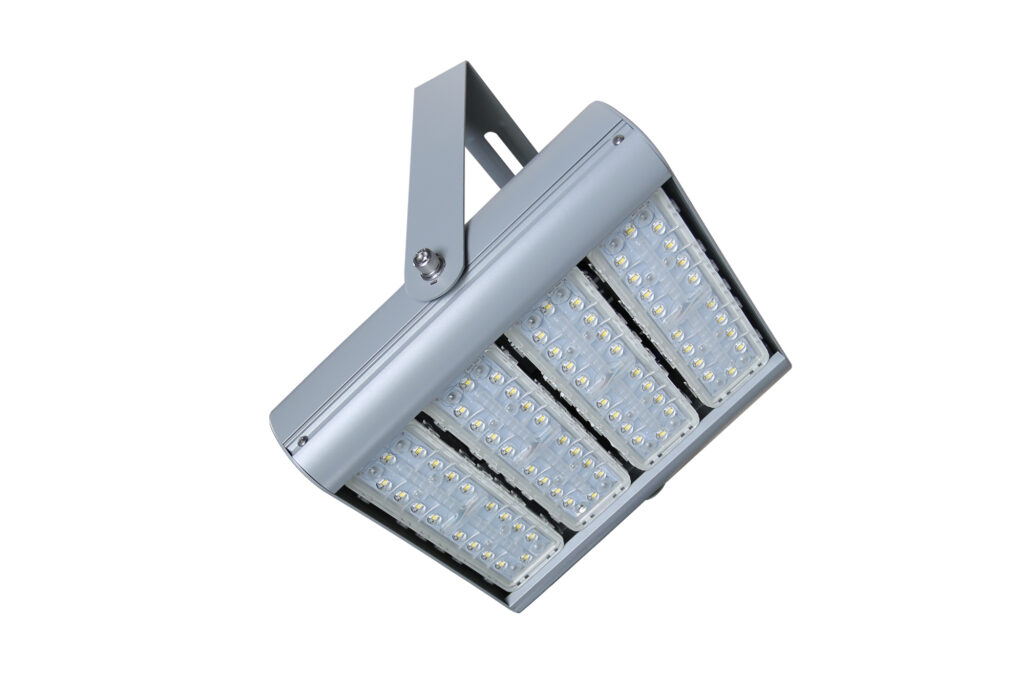
The modular high bay takes a fundamentally different approach to fixture architecture. Rather than a single sealed unit, it consists of a central aluminium hub onto which between 1 and 7 individual LED modules can be independently attached or removed. Each module is self-contained and connects via a double-coupling IP68-rated connector. This design delivers three operational advantages that no UFO fixture can replicate:
- Scalable wattage: Configure from 30W (1 module) up to 400W (7 modules) using the same fixture frame. As facility requirements change — new racking, a mezzanine installation, reclassified work zones — the wattage can be adjusted in the field without purchasing a new fixture.
- Hot-pluggable maintenance: Each module uses Philips Lumileds flip-chip LED technology, which eliminates the gold wire bond — the primary failure mode in conventional LED packages. If a module does fail, it is removed and replaced on-site in minutes while the remaining modules continue operating. There is no production shutdown, no cherry-picker hire, no full fixture replacement.
- IP68 module-level protection: The double-coupling connector on each module is individually rated to IP68 — the highest waterproof standard in IEC 60529, indicating protection against continuous immersion. This makes the modular series the correct choice for food processing lines, cold storage, chemical manufacturing, and any environment subject to high-pressure wash-down procedures.
Thermal management uses a proprietary honeycomb briquette heat-sink principle combined with a whole-structure integral cooling design, treating the aluminium housing as a single thermal mass. Lumen maintenance is rated L70 at 50,000 hours. Housing is available in black, white, grey, and blue.
→ Modular LED High Bay Light — product page: haichanglight.com/product/5-modulars-led-high-bay/
UFO vs modular: head-to-head comparison table
The table below summarises the key specification differences between the two platforms to support direct comparison.
| Feature | UFO LED High Bay | Modular LED High Bay |
| Form factor | Compact disc, single unit | Hub + 1–7 plug-in modules |
| Power range | 100W – 200W (UX10 / UA9) | 30W – 400W (1–7 modules) |
| Efficacy | 180–190 lm/W | ~130–150 lm/W |
| IP rating | IP65 (whole fixture) | IP68 per module connector |
| Impact resistance | IK10 | IK10 |
| Maintenance | Full fixture swap | Hot-swap individual module |
| Dimming | DALI / 0-10V / PWM | 0-10V compatible |
| Lifespan (L70) | 50,000 h+ | 50,000 h+ |
| LED source | UA9: Philips + Meanwell driver | Philips Lumileds flip-chip |
| Best ceiling height | 5 – 15 m (13–50 ft) | 8 – 15 m+ (26 ft+) |
| Best for | General warehouse, gym, retail, car park | Food processing, heavy industry, washdown |
Key specs you must understand before buying LED high bay lights
Industrial lighting specifications are frequently misused in purchasing decisions. The following five parameters are the ones that determine real-world performance and long-term cost of ownership.
Efficacy (lm/W) — why it matters more than wattage
Luminous efficacy is the ratio of light output (lumens) to electrical input (watts). It is the single most important efficiency metric for an LED high bay, yet it is consistently overlooked in favour of wattage comparisons.
Consider two 200W UFO fixtures: a budget unit at 120 lm/W produces 24,000 lumens; the Haichang UA9 Series at 190 lm/W produces 38,000 lumens from the same power draw. The UA9 delivers 58% more light for identical energy consumption. Specifying by wattage alone and ignoring lm/W is the most common cause of under-lit industrial installations.
Lumen maintenance L70 @ 50,000 hours — what the number means
L70 is the rated operating hours at which a fixture still delivers at least 70% of its initial lumen output. At that threshold, the facility manager should consider replacement. For Haichang’s UFO and modular series, L70 is rated at 50,000 hours. Running at 18 hours per day, that equates to approximately 7.6 years before lumen output falls below 70% of original.
Compare this to a 400W metal halide lamp, which typically requires relamping every 12,000–20,000 hours — meaning two to four full lamp replacements within the same service period as a single LED fixture. The labour cost of high-bay relamping (requiring elevated access equipment) often exceeds the cost of the lamp itself.
IP65 vs IP68 — which waterproof rating does your facility need?
The IP (Ingress Protection) rating describes resistance to solid particles and liquids. For industrial high bay selection, the relevant distinction is:
- IP65: Fully dust-tight; protected against low-pressure water jets from any direction. Suitable for general warehouses, manufacturing plants, car parks, and most outdoor canopy applications.
- IP68: Fully dust-tight; protected against continuous immersion in water at a defined depth and duration. Required for food processing lines, cold-storage and blast-freeze rooms, chemical and pharmaceutical manufacturing, and any space subject to high-pressure wash-down procedures.
The IP68 rating on Haichang’s modular high bay is applied at the module connector level individually — not as a single whole-fixture nominal rating. This means each of the 1–7 module junctions is independently sealed to IP68, providing full protection even when operating with a partial module configuration.
IK10 impact resistance — why it matters in industrial environments
The IK code rates a fixture’s resistance to mechanical impact. IK10 — the highest defined level — indicates protection against an impact of 20 joules, equivalent to a 5 kg mass dropping from 40 cm. Both the UX10 and UA9 UFO series carry IK10 certification.
In warehouses and manufacturing plants, high-bay fixtures are routinely struck by forklift masts, pallet loads shifted by overhead cranes, and debris from production processes. A fixture rated below IK10 will typically shatter the diffuser or deform the housing under these conditions, requiring replacement. An IK10-rated fixture survives the same impact undamaged.
CCT and CRI — choosing colour temperature for your application
Correlated Colour Temperature (CCT) and Colour Rendering Index (CRI) are distinct specifications that are frequently conflated.
- CCT: 4,000K (neutral white) suits general manufacturing and warehouse storage — it provides good visual clarity without the harshness of cooler sources. 5,000–5,700K (cool white / daylight) is preferred for high ceiling heights where colour contrast aids depth perception, and for picking lines where worker alertness is a priority.
- CRI: CRI > 80 is the minimum for general industrial use. CRI > 90 is required for QC inspection lines, colour-matching operations, and food presentation areas where accurate colour rendering directly affects work quality.
How to calculate how many LED high bay lights you need
Three inputs determine the correct fixture count: the required illuminance level, the floor area, and the fixture’s lumen output. The following step-by-step method covers 90% of standard industrial projects.
Step 1 — Set your target lux level by application
Illuminance requirements vary significantly by task type. The table below is derived from EN 12464-1 (Lighting of indoor work places).
| Application | Target lux (EN 12464-1) | Recommended type |
| General storage / bulk warehouse | 200 lux | UFO 100–150W |
| Order picking / packing lines | 300–500 lux | UFO 200W or Modular 3-mod |
| Manufacturing / assembly | 500–750 lux | Modular 4–5 modules |
| Fine inspection / QC lines | 1,000 lux | Modular 6–7 modules |
| Gymnasium / sports hall | 300–500 lux | UFO 150–200W |
Step 2 — Apply the lumen calculation formula
The standard formula for estimating fixture count is:
Number of fixtures = (Target lux × Floor area m²) ÷ (Fixture lumens × Utilisation factor)
Use a utilisation factor of 0.65 for a standard warehouse with medium-reflectance walls and ceiling (common for new installations). For older facilities with dark surfaces, use 0.55.
Worked example — 2,000 m² distribution centre targeting 300 lux:
- Using Haichang 200W UFO UA9 (190 lm/W = 38,000 lumens/fixture):
- Fixtures = (300 × 2,000) ÷ (38,000 × 0.65) = 600,000 ÷ 24,700 ≈ 24 fixtures
- Using Haichang Modular 7-module (400W ≈ 56,000 lumens/fixture):
- Fixtures = (300 × 2,000) ÷ (56,000 × 0.65) = 600,000 ÷ 36,400 ≈ 17 fixtures
Step 3 — Mounting height and spacing reference
Use the table below as a starting point for fixture spacing. These are guideline values for typical warehouse applications with an open plan layout; complex spaces or specific uniformity requirements should be verified with a full photometric calculation.
| Ceiling height | Recommended fixture | Typical wattage | Fixture spacing |
| 5 – 8 m | UFO UX10 | 100–150W | 4 – 5 m centres |
| 8 – 12 m | UFO UA9 / Modular 3–4 mod | 150–240W | 5 – 7 m centres |
| 12 – 15 m | Modular 5–7 mod | 300–400W | 6 – 8 m centres |
LED high bay lights vs metal halide: energy savings, ROI, and real numbers
The business case for converting from metal halide to LED high bay lighting involves three distinct cost streams: energy consumption, lamp replacement cycles, and fixture purchase cost. The following analysis uses a realistic 20-fixture scenario at 18 operating hours per day.
True system wattage: why the nameplate figure understates metal halide energy use
A 400W metal halide lamp does not draw 400W from the mains. The electromagnetic ballast adds 10–15% parasitic consumption, bringing the true system draw to approximately 458W per fixture. An LED high bay has no ballast — the driver is integrated or remote-mounted with negligible loss, and the fixture draws exactly its rated wattage.
| 400W Metal Halide | 200W UFO UA9 LED | |
| True system wattage | ~458W (lamp + ballast) | 200W (no ballast) |
| Annual energy cost (20 fixtures, 18h/day, $0.12/kWh) | $7,215 | $3,153 |
| Annual energy saving | — | $4,062 (56%) |
| Relamping cost (20 lamps, every 3 years) | ~$1,000/year | Negligible |
| Typical payback period | — | 1.5 – 2.5 years |
Do I need to remove the ballast when retrofitting to LED high bay?
Yes. LED high bay lights operate via an integrated LED driver and are not compatible with the existing HID ballast. When retrofitting, the metal halide ballast must be bypassed or removed. The line voltage (typically 100–277V AC) connects directly to the LED driver input. Haichang’s UFO and modular series both accept universal input voltage, simplifying retrofit in facilities with mixed electrical infrastructure.
Haichang LED high bay lights: UFO and modular series for every industrial application
Haichang Optotech is a China-based manufacturer of industrial and commercial LED lighting with full CE and RoHS certification across all product lines. All high bay fixtures carry a 3-year warranty as standard, with 5-year warranty available on selected series. The company operates its own production facility and offers custom configurations — including specific wattages, colour temperatures, beam angles, and housing colours — for project-scale orders.
UFO LED high bay series: UX10 and UA9
The UX10 Series (100W / 150W / 200W) offers 180 lm/W efficacy in an ADC12 die-cast aluminium housing, making it the cost-effective choice for standard warehouses, car parks, gymnasiums, and general manufacturing at ceiling heights from 5 to 12 metres. Full dimming support (DALI / 0-10V / PWM) and external motion sensor compatibility are standard.
The UA9 Series (150W / 200W) steps up to 190 lm/W with Philips-sourced LED chips and a Meanwell driver — the specification that premium commercial and industrial projects demand. The fin heat-sink design and IK10 / IP65 construction make it equally appropriate for demanding outdoor canopy or partially-covered loading dock installations.
→ View UFO LED High Bay range: haichanglight.com/product-category/led-industrial-lighting/ufo-led-high-bay-lights/
Modular LED high bay series: 1–7 modules, 30W–400W
The modular series is Haichang’s specification-grade product for environments where IP65 protection is insufficient, where wattage flexibility is operationally valuable, or where maintenance access is restricted. The combination of Philips Lumileds flip-chip modules, double-coupling IP68 connectors, and hot-pluggable architecture makes it the only high bay fixture type that does not require a full shutdown for maintenance — a critical advantage in 24/7 production facilities.
→ View Modular LED High Bay: haichanglight.com/product/5-modulars-led-high-bay/
Frequently asked questions about LED high bay lights
Q1: What is the difference between UFO and modular LED high bay lights?
A UFO high bay is a single sealed unit — the entire fixture is replaced if it fails. A modular high bay consists of individual LED modules that plug into a central hub and can be replaced one at a time without removing the fixture. Modular types also allow wattage adjustment by adding or removing modules (30W–400W), which UFO fixtures do not support.
Q2: How many lumens do I need for a 10-metre ceiling?
For a 10-metre ceiling in a general warehouse targeting 300 lux, each fixture should deliver approximately 28,000–38,000 lumens, assuming a spacing of 5–6 metres between fixtures and a utilisation factor of 0.65. A 200W UFO UA9 (190 lm/W = 38,000 lm) or a 3-to-4-module modular high bay at 150–200W will typically meet this requirement.
Q3: Can a 200W LED high bay replace a 400W metal halide lamp?
Yes. A 200W UFO LED high bay at 190 lm/W produces 38,000 lumens. A 400W metal halide lamp at initial output produces approximately 36,000–40,000 lumens — but metal halide output degrades rapidly (to 70% within 10,000–12,000 hours), while the LED fixture maintains L70 for 50,000 hours. For this reason, a 200W LED is considered a direct functional replacement for a 400W metal halide in most warehouse applications.
Q4: What IP rating do I need for a food processing or washdown environment?
Food processing lines, cold-storage rooms, and any area subject to high-pressure wash-down require IP68 protection. IP65 — the rating on standard UFO high bays — is not sufficient for continuous or high-pressure water exposure. Haichang’s modular high bay series provides IP68 protection at each module connector individually, making it the appropriate choice for these environments.
Q5: How far apart should LED high bay lights be spaced?
Spacing depends on ceiling height and target lux level. As a general rule: 4–5 metre centres for 5–8m ceilings (100–150W UFO), 5–7 metre centres for 8–12m ceilings (200W UFO or 3–4 module modular), and 6–8 metre centres for 12m+ ceilings (5–7 module modular, 300–400W). These are starting-point estimates — a full photometric layout calculation is recommended for precise specification.
Q6: What does L70 at 50,000 hours mean for LED high bay lights?
L70 is the IES-defined point at which a fixture’s lumen output has declined to 70% of its initial value. At 50,000 hours rated L70, an LED high bay running 18 hours per day will still be producing at least 70% of its original light output after approximately 7.6 years. Below L70, most applications will begin to show under-illuminance, and replacement should be planned.
Q7: Do I need to remove the ballast when replacing metal halide with LED high bay?
Yes. LED high bay lights are driven by an integrated LED driver and are not compatible with the existing HID ballast. The ballast must be bypassed or removed, and the line voltage connects directly to the LED driver input. Haichang’s UFO and modular series accept universal input voltage (typically 100–277V AC), so no additional electrical work is required beyond disconnecting the ballast.
Q8: What colour temperature is best for warehouse and factory lighting?
4,000K (neutral white) is the most versatile choice for general warehouses and manufacturing — it provides good colour rendering and visual clarity without fatigue. 5,000K is preferred for very high-ceiling installations (12m+) where the cooler tone compensates for the distance to the working plane, and for pick-and-pack zones where worker alertness is important. Avoid 3,000K (warm white) in industrial settings — it reduces perceived brightness and makes it harder to distinguish product colours.
Q9: What is a hot-pluggable LED module and how does it reduce maintenance downtime?
A hot-pluggable module is a self-contained LED unit that can be connected to or disconnected from the fixture while the other modules continue to operate. On the Haichang modular high bay, each module attaches via a double-coupling IP68 connector. If one module fails, a technician removes it and installs a replacement in minutes — without a cherry-picker for the entire fixture, without shutting down production, and without the other modules going dark. This is the primary operational advantage of the modular platform over sealed UFO fixtures in 24/7 facilities.
Q10: How long is the payback period for switching from metal halide to LED high bay lights?
For a typical 20-fixture installation replacing 400W metal halide with 200W LED high bays, the combined energy saving and elimination of relamping costs delivers a payback period of approximately 1.5–2.5 years at $0.12/kWh electricity cost. Higher energy costs or longer operating hours shorten the payback period further. After payback, the net annual saving continues for the remaining service life of the LED fixture.
Q11: Can LED high bay lights be used outdoors or in partially covered areas?
Yes. Haichang’s UFO high bay series (IP65) is suitable for partially covered outdoor areas including loading dock canopies, covered walkways, and outdoor car parks. The modular high bay (IP68 per module) is appropriate for fully exposed outdoor industrial installations. Both series are rated for a wide operating temperature range and use aluminium housings that resist the thermal cycling of outdoor environments.
Need help specifying the right LED high bay for your project?
Haichang Optotech provides free lighting layout calculations and project quotations for any facility size. Send your floor plan, ceiling height, and target lux requirements to our technical team at haichanglight.com/contact/ and we will return a complete fixture schedule, spacing plan, and itemised quotation within 24 hours.
Request a free lighting layout calculation and project quotation — haichanglight.com/contact/
