

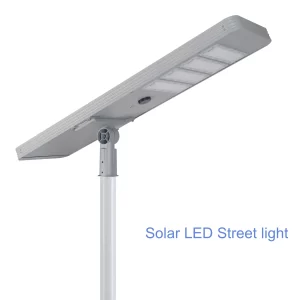
Modern solar LED street lights are a fully self-contained outdoor lighting solution that requires no grid connection, no trenching, and no ongoing electricity bills. For a typical 6-meter pole road installation, a 40W–80W all-in-one solar LED street light with a LiFePO4 (lithium iron phosphate) battery provides 8–12 hours of illumination per night and can sustain operation through 3–5 consecutive cloudy or rainy days without sunlight. This guide explains everything procurement managers, project engineers, and lighting distributors need to know before buying — including the critical choice between all-in-one and split systems, what LiFePO4 means for battery life, and how to assess real-world rainy day performance.
What Is a Solar LED Street Light and How Does It Work?
A solar LED street light is an outdoor luminaire that generates, stores, and uses its own electricity entirely from solar energy. The system consists of four core components working together:
1. Solar Panel — Monocrystalline silicon cells (efficiency >22%) absorb sunlight during the day and convert it to DC electricity. The panel is either built into the light body (all-in-one) or mounted separately on the pole or ground (split system).
2. Battery — Stores the energy generated during the day for use at night. Modern premium units use LiFePO4 (lithium iron phosphate) chemistry, which is far superior to older lead-acid or standard lithium-ion batteries. See the battery section below for a full comparison.
3. MPPT Intelligent Controller — Maximum Power Point Tracking (MPPT) technology continuously optimizes the charging process to extract maximum energy from the solar panel, even under partial shade or low-light conditions. Charging efficiency reaches up to 98% with MPPT controllers, compared to ~70–80% with conventional PWM controllers.
4. LED Light Module — High-efficacy LED chips (typically 3030 or 5050 SMD LEDs) deliver bright, directional road lighting. Premium models reach 160–200 lm/W, meaning a 50W solar street light produces as much usable light as a 150W+ traditional HPS lamp.
How the night cycle works: At dusk, the light sensor (or timer) activates the LED module automatically. The MPPT controller draws power from the battery throughout the night. At dawn, the system switches off and begins recharging the battery for the next cycle.
All-in-One Solar Street Light vs Split Solar Street Light: Full Comparison
This is the most important buying decision. All-in-one (integrated) and split (separate panel) systems each have meaningful advantages depending on your project conditions.
All-in-One (Integrated) Solar Street Light
In an all-in-one design, the solar panel, battery, LED module, and controller are all integrated into a single compact housing that mounts directly onto the pole arm. There are no external cables, no separate panel bracket, and no underground wiring.
Best for: Roads, pathways, parking lots, parks, sidewalks, residential areas, and any installation where simplicity and fast deployment are priorities.
Split Solar Street Light
In a split design, the solar panel is mounted separately — typically on top of the pole or on an adjacent structure — while the battery is housed in a ground-level enclosure or separate compartment. This allows a larger solar panel surface area.
Best for: High-latitude regions (above 45°N or below 45°S) with low winter sun angles, locations with partial pole shading, or high-power applications above 200W equivalent output.
Head-to-Head Comparison Table
| Feature | All-in-One Solar Street Light | Split Solar Street Light |
|---|---|---|
| Installation | Simple – single pole mount, no cabling | Complex – panel bracket + battery box + cabling |
| Installation Time | 30–60 minutes per unit | 2–4 hours per unit |
| Aesthetics | Sleek, modern, compact | Bulkier, visible panel & cables |
| Panel Size Limit | Limited by housing size | No limit – larger panels possible |
| Best Latitude Range | Equator to ~45° (high solar irradiance) | All latitudes, especially >45° |
| Maintenance | Easy – battery, panel, LED each replaceable separately | Battery box may require separate access |
| Wind Resistance | Excellent – low-profile, IK10 rated models available | Panel adds wind load; requires engineering check |
| Cost | Lower overall (unit + labor) | Higher (larger panel, more labor) |
| Power Range | 30W – 200W | 100W – 500W+ |
| Typical Applications | Streets, parks, sidewalks, parking, gardens | Highways, main roads, high-power commercial |
| Theft Risk | Lower (integrated, harder to steal parts) | Higher (separate battery box is a target) |
Bottom line: For the majority of projects — especially in Asia, Africa, the Middle East, South America, and southern Europe — all-in-one solar street lights are the recommended choice due to lower installation cost, cleaner appearance, and sufficient solar irradiance.
LiFePO4 Battery: Why It Matters for Solar Street Lights
The battery is the component that determines whether a solar street light performs reliably over 5–10 years or degrades and fails within 2–3 years. Understanding battery chemistry is essential for any B2B buyer.
Battery Chemistry Comparison
| Battery Type | Cycle Life | Operating Temp | Safety | Self-Discharge | Cost |
|---|---|---|---|---|---|
| LiFePO4 ✅ | 2,000–3,000+ | -20°C to +60°C | Excellent | Very Low <3%/mo | Medium-High |
| Standard Li-Ion (NMC) | 500–1,000 | 0°C to 45°C | Moderate | Low | Medium |
| Lead-Acid (GEL) | 300–500 | 0°C to 40°C | Good | High 10–15%/mo | Low |
| Ternary Lithium | 800–1,200 | -10°C to 50°C | Lower | Low | Medium |
Why LiFePO4 is the Standard for Quality Solar Street Lights
1. Temperature Resilience. LiFePO4 cells maintain stable performance from -20°C to +60°C. Standard lithium-ion batteries lose 30–50% capacity at -10°C, while LiFePO4 retains over 80% capacity at the same temperature. In hot climates (Middle East, Southeast Asia, Africa), LiFePO4’s tolerance of +60°C prevents the accelerated degradation that ruins standard batteries within a single summer.
2. Cycle Longevity. With 2,000–3,000+ charge-discharge cycles, a LiFePO4 battery lasts 8–10 years in daily solar street light use. A lead-acid battery may only last 1.5–2 years under the same conditions.
3. Safety. LiFePO4 chemistry does not experience thermal runaway — the dangerous chain reaction that causes fires in some lithium-ion batteries. For public infrastructure installed on streets and in parks, this is a non-negotiable safety advantage.
What capacity should you specify? For a 50W LED module requiring 12 hours per night with 5 rainy day backup: 50W × 12h × 5 days ÷ 0.85 = approximately 3,530 Wh (e.g., 25.6V × 150Ah = 3,840 Wh).
Rainy Day Performance: How Many Days Without Sun?
This is the most frequently asked question from buyers in tropical, monsoon, and northern hemisphere markets. The answer depends on three variables: battery capacity, LED wattage, and operating hours per night.
Formula: Backup Days = (Battery Capacity in Wh × 0.85) ÷ (LED Wattage × Hours per Night)
Example: 80W LED, 12h/night, 3,840 Wh battery → (3,840 × 0.85) ÷ (80 × 12) = 3.4 days
Rainy Day Backup by Wattage
| LED Wattage | Battery Capacity | Daily Energy Use | Rainy Day Backup |
|---|---|---|---|
| 30W | 576 Wh | 360 Wh/night | ~1.3 days |
| 50W | 1,280 Wh | 600 Wh/night | ~1.8 days |
| 80W | 3,840 Wh | 960 Wh/night | ~3.4 days |
| 100W | 5,120 Wh | 1,200 Wh/night | ~3.6 days |
| 150W | 7,200 Wh | 1,800 Wh/night | ~3.4 days |
Figures assume 12h operating time and 85% battery usable depth of discharge (DoD). Smart dimming can extend backup to 4.5–5 days.
How Smart Dimming Extends Rainy Day Performance
Premium solar street lights use intelligent time-based dimming programs to extend backup days by 35–40%:
- Hour 1–2 after sunset: 100% brightness (peak pedestrian/traffic activity)
- Hour 3–6: 70% brightness
- Hour 7–10: 50% brightness
- Hour 11–12 before dawn: 30% brightness
Radar motion sensors add another layer: light stays at 30–50% standby and jumps to 100% only when movement is detected. In low-traffic areas this cuts energy use by an additional 20–30%.
Technical Specifications: What to Check Before Buying
| Specification | What to Look For ✅ | Red Flag ⚠️ |
|---|---|---|
| Solar Panel | Monocrystalline, >22% efficiency | Polycrystalline or efficiency not stated |
| Battery Type | LiFePO4 explicitly stated | “Lithium battery” with no chemistry specified |
| Battery Capacity | Stated in Wh or V×Ah | “Large capacity” with no numbers |
| Controller | MPPT, ≥95% efficiency | PWM controller (15–25% less efficient) |
| LED Efficacy | ≥160 lm/W | <120 lm/W = outdated LED |
| IP Rating | IP65 minimum; IP66 for coastal areas | IP44 or lower |
| IK Rating | IK08 or IK10 for public areas | No IK rating stated |
| Operating Temp | -20°C to +60°C | Narrower range = inferior battery |
| Control Options | Light sensor + radar + time control | Light sensor only |
| Warranty | 3 years minimum | Less than 2 years |
| Certifications | CE, RoHS; TUV preferred | No third-party certs |
Wattage Selection Guide by Application
| Application | Pole Height | Recommended Wattage | Road Width Coverage |
|---|---|---|---|
| Garden path / Walkway | 3–4m | 20W–30W | 4–6m width |
| Residential side street | 4–6m | 30W–50W | 6–8m width |
| Urban secondary road | 6–8m | 60W–100W | 8–10m width |
| Main urban road | 8–10m | 100W–150W | 10–14m width |
| Highway / Arterial road | 10–15m | 150W–200W | 14–20m width |
| Parking lot | 5–8m | 50W–80W | 15×15m area per unit |
Frequently Asked Questions About Solar LED Street Lights
How long do solar LED street lights last without sun?
A quality solar LED street light with a properly sized LiFePO4 battery can operate for 3–5 consecutive cloudy or rainy days without any solar recharge. For monsoon regions, specify at least 5-day backup capacity and enable smart dimming to conserve battery during extended overcast periods.
What is the lifespan of a solar LED street light?
The LED module lasts 50,000+ hours (11+ years at 12h/night). The LiFePO4 battery maintains >80% capacity for 2,000–3,000 cycles (6–10 years). The solar panel degrades at ~0.5%/year, maintaining >90% output after 10 years. With modular replacement of battery, panel, and LED independently, total system lifespan can exceed 10–15 years.
What is the difference between all-in-one and split solar street lights?
All-in-one units integrate the solar panel, battery, LED, and controller into a single housing that mounts on the pole arm — easier to install, more aesthetically pleasing, lower total cost. Split systems mount the solar panel separately, allowing larger panel size. All-in-one is recommended for most projects; split is better for high-latitude or very high-power applications.
Why is LiFePO4 better than lead-acid battery for solar street lights?
LiFePO4 lasts 5–6× longer (2,000–3,000 cycles vs. 300–500 cycles), operates from -20°C to +60°C without degradation, has very low self-discharge, and requires zero maintenance. The total cost of ownership over 5 years is 40–60% lower than lead-acid because no battery replacement is needed.
How does the radar sensor work on solar street lights?
A microwave radar sensor monitors for movement within a 5–12 meter radius. When a pedestrian or vehicle is detected, the light activates to 100% brightness. After 30–60 seconds with no movement, it returns to 30–50% standby brightness. This reduces energy consumption significantly during low-traffic hours without compromising safety.
Can solar street lights work in very cold climates?
Yes — with LiFePO4 batteries only. Haichang solar street lights are rated to -20°C and have been deployed in northern China, Eastern Europe, and Canada. Standard lithium-ion batteries lose 30–50% capacity at freezing temperatures and are not suitable for cold-climate projects.
What certifications should solar street lights have?
CE (required for EU markets), RoHS compliance, and IP65+ waterproof rating are the minimum requirements. For government tenders or large infrastructure projects, TUV or IEC 62133 battery certification provides additional safety assurance. Always request original test reports.
Haichang Optotech Solar LED Street Light Products
Haichang Optotech (established 2008, Shenzhen, China) manufactures a complete range of all-in-one integrated solar LED street lights from 40W to 200W — all with LiFePO4 batteries, MPPT controllers, dual radar + light sensors, and IP65 weatherproof aluminum construction. CE and RoHS certified. Poles available.
SSL-T300C — 80W
Secondary roads, parking lots
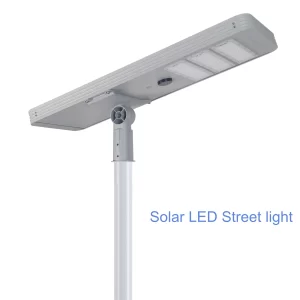
SSL-T300B — 50W
Parks, sidewalks, residential

SSL-AF389D — 150W
Main roads, arterial streets
Full Product Line
| Model | Power | Key Feature | Best Application |
|---|---|---|---|
| SSL-T300A | 40W | Light + Radar, LiFePO4, IP65 | Garden paths, walkways, residential |
| SSL-T300B | 50W | Light + Radar, LiFePO4, IP65 | Residential streets, parks, sidewalks |
| SSL-T300C | 80W | Light + Radar, LiFePO4, IP65 | Secondary roads, parking lots |
| SSL-AF389A | 80W | Integrated MPPT, radar, IP65 | Urban roads, parks, post-top |
| SSL-AF389B | 100W | High output, MPPT, radar, IP65 | Main streets, commercial areas |
| SSL-AF389C | 120W | 200lm/W high brightness, MPPT | Urban main roads, wide sidewalks |
| SSL-AF389D | 150W | Maximum output, full smart control | Main roads, arterial streets |
| SSL-T35 | 100W | Modular replaceable battery design | Versatile urban & suburban |
| SSL-T41 | 150W | Heavy-duty durable pole system | High-traffic roads, commercial streets |
All models include: LiFePO4 battery · Monocrystalline solar panel (>22%) · MPPT controller (98%) · Radar + light sensor · Time dimming program · -20°C to +60°C · IP65 · CE & RoHS · 3-year warranty
OEM orders accepted — custom wattage, beam angle, pole height, and dimming programs available for bulk projects.
👉 View All Solar Street Light Products
📩 Get a Project Quotation
Haichang Optotech Co., Limited | LED Lighting Manufacturer since 2008 | Shenzhen, China | CE · RoHS · TUV Certified | Export to 50+ Countries
